Latest News
Latest News
May 2019
Latest news from Château La Clarière
What news to greet you with – a Trophy for our Château La Clarière 2017 ... Best French Wine Trophy, in fact. We are very proud and a case of this will be heading your way in June, unless you’ve only signed up for our château white. Something to look forward to, for sure.
Just how we managed a Trophy in 2017:
It’s a strange thing at Château La Clarière – we love an ‘off’ vintage. More accurately, I should call it a challenging vintage – it was a tough year with some excellent results, as highlighted by many of the critics: “brilliant wines” (Jeb Dunnock), “2017 is all about finesse, perfume and aromatic intensity” (RobertParker.com), “some excellent wines” (Decanter).
We’ve been really lucky just recently to have the exceptional 2015 vintage (nine Golds so far) – such luscious fruit – followed by the impressive and a little sturdier 2016 (another five Golds), both outstanding years. Then there was 2017 and its Trophy and two Golds. It wasn’t such an easy one. Compare it to the situation in 2011, a year that followed on from the two 5-Star vintages of ‘09 and ‘10. Yet, La Clarière seemed to show at its best in 2011 and now in 2017. Perverse possibly, but we are all delighted with the 2017 wine. “Stunning” says Jean-Marc, and seemingly the judges at the Wine & Spirit Awards, felt the same, giving it that top spot of Trophy.
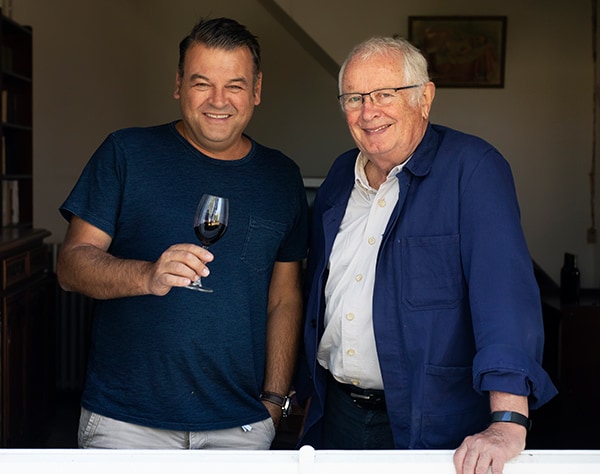
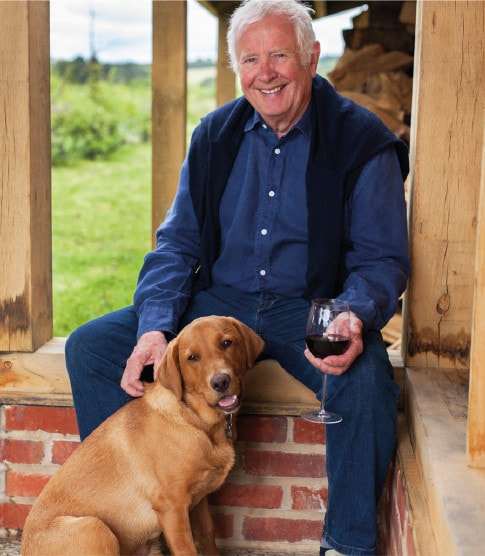
Jean-Marc and I welcome you to the lovely château and the Trophy-winning Château La Clarière 2017
So, 2017 was, as you’ll remember, the year of the dreadful spring frost, with yields in Bordeaux down 45%. Frost hadn’t hit so hard since 1991. It struck in late April, the 27th being the coldest and most devastating. Estates lit the bougies, the fires, in the vineyard, they weren’t slacking, but for some it was just too deep a frost to avoid and the worst had total wipe-out. For La Clarière, we were lucky and lost just 5%
I say ‘lucky’, but actually, when you talk to Jean-Marc, he puts me straight. It’s nothing to do with luck; it’s all to do with health of the vineyards. Perhaps that’s why 80% of the Grands Vins all over Bordeaux were unaffected by the frost.
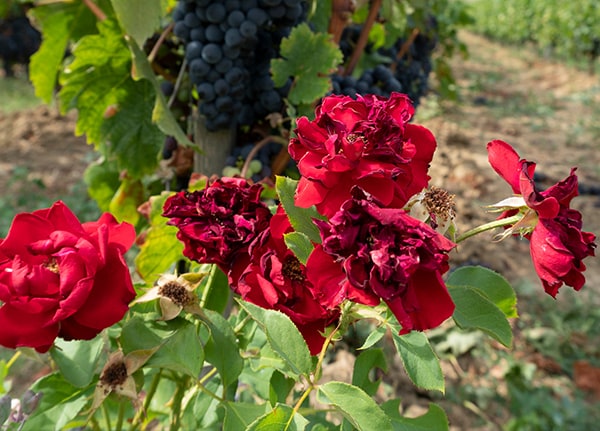
We work hard in the vineyard to ensure the soils are well balanced to support the vines. These red roses are traditionally planted to show first signs of any mildew, but look pretty too
Rude health in the vineyard:
A number of years back, we employed a top-notch viticultural consultant – no skimping, he was one of the best names in Bordeaux. J-M and our estate manager, Vincent, learnt a lot and continue his good work today. However, Bernard (his name) has gone now and, for the last four years, we have consulted Mathieu Bellet, a soil man. This is all J-M wants – someone who teaches them how to get the most life into the earth ... to help them examine every parcel, analyse it at different depths and decide what’s there and what’s missing. We’re not talking about adding chemicals, of course. Oh no ... only natural additions to give the soil a boost and make it stronger. This, in turn, gives life and vigour to our vines, to make them stronger and able to withstand frosts that bite as hard as -4, as well as pests, mildew or whatever is thrown at them.
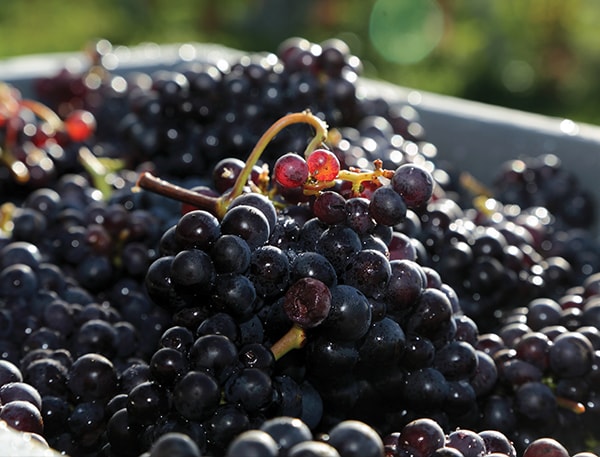
We were blessed with a great vintage in 2017, hardly touched by frost and the fruit quality was all there
You see, as J-M patiently explains, if the soil doesn’t have proper balance, if there’s a missing element, then it can’t absorb the good things you feed it. So, we’ve learnt, and it is the hot topic of the moment, soil life is all important. A lesson for all farming, perhaps, but let’s not stir that pot!
In 2017, we had vineyards, right at the top on the plateau, above the château, mostly Merlot with a row or two of Malbec, that possibly produced the best quality grapes. In fact, these were our youngest vines, but we’d worked hard right from the start to get the balance spot on. We felt we had used the best rootstocks, matched those to the best clones and got them absolutely on target. This cuvée has added even greater depth to the blended wine.
In fact, we’ve changed the nursery we get our clones from ... to the same as our good friend Ludovic Roussillon. He knows what he’s talking about and we liked what we saw.
Onto your 2017 wine:
2017 saw no difference in our formula of grapes – we used 80% Merlot, plus 10% Cabernet Sauvignon and 5% each of Malbec and Cabernet Franc. For years, we’ve done a visual sorting when the fruit comes into the cellar – removing any berry that doesn’t look ripe or isn’t in the peak of health. Now we’ve added a density check, too. They do this at Haut-Brion and a number of other first-class properties. We fill a ‘bath’ of our own grape juice, set to a baumé of the desired 13.5-14% alc. The grapes are destalked and all enter the pool of juice. If the berries aren’t fully ripe (ie below 13.5-14%), they float and are removed. It’s so simple, yet very effective. All the ripe ones are carried away on a little conveyor belt and gently dropped into the maceration tank. Nifty!
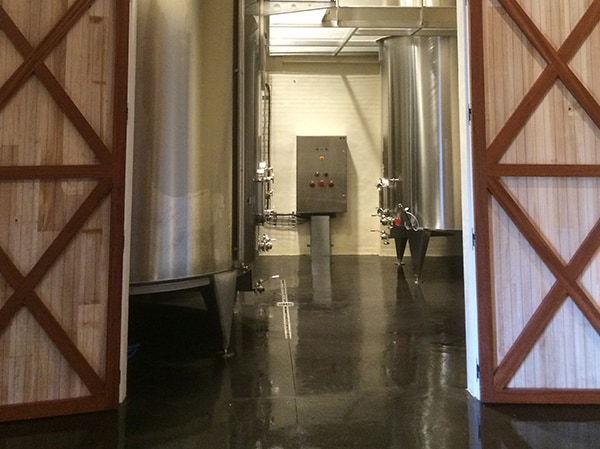
Peek inside this new part of our chai to see a row of three new blending vats. They will help the team no end
After the soak of the skins with the juice, there’s fermentation with pump over of the liquid and plunge down of the skins ... all the normal routine. A gentle pressing (to avoid harsh extraction flavours) and the wine is put into barrel. In 2017, we followed the barrel-age rule again – casks were one third new, one third one-year-old, one third two years. We like to use a mixture of coopers – it seems to suit the wine. So we source our barrels from the top names – Taransaud, Seguin et Moreau and Ana Séléction, possibly our favourite. Why? They are a small cooper with a big forest (it’s usually the other way round). So, they sell off some wood, keeping the very best cuts for their own barrels. They’re advised by Stéphane Derenoncourt, a top consultant many of you will already have heard of, so it’s perhaps no surprise.
So, that’s the wrap up for 2017. We are just about to take the wine, gently, out of barrel, filter, fine and bottle it. J-M loves the wine, says it has a long life ahead of it. This was his note on it:
Not as opaque as 2016, but nonetheless it’s a deep crimson purple, giving up aromas of juicy, ripe plum, blackberry, cassis and blackcurrant leaf, with a lovely strong note from the new oak. Velvety, dense black fruit, creamy even, but below that are some firm tannins. It’s no push over. Long flavours of creamy ripe black fruits, toasty new oak and a firm tannic structure. Definitely a claret to open early or tuck away for any time between Christmas 2019 and 2031.
New kit in the cellar in 2018:
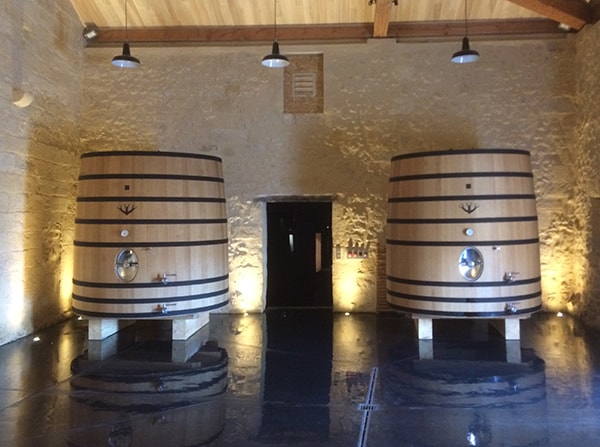
So what’s new inside the cellar? We bought two large wooden tanks for ageing – beautiful foudres. For this year, they are new wood (ie we won’t be buying them every year), so we will be experimenting to see how that affects the flavour, complexity and structure in the wine.
These are the beautiful new wooden tanks – foudres, so larger than barriques – that we will use experimentally for ageing
As some of you will remember, we have also extended our barrel cellar. Now it also includes a trio of blending vats, so we can do this job more easily and effectively. It’s less arduous when we come to do the racking as well – every few months, the wine in barrel is drawn off its lees, the cask is cleaned and the wine is returned.
Talking about barrel cleaning ... that is probably our most exciting bit of new kit, according to J-M anyway. He describes it as a ‘Swedish sauna for barrels’! Each barrel has this dryish vapour pumped in that makes the inside of the barrel sweat, releasing any toxins or bacteria in the wood. It takes about 3-4 minutes for each barrel, slower perhaps that the high-pressure hot-water hose, but provides a deeper and more gentle clean, and saves a lot of scrubbing. Understandably it’s a popular new addition to the ‘team’.
And in the château:
Jean-Marc is still hard at work on his interior designs. Judging from the expenses, it’ll be very lovely indeed, but I’m afraid it’ll be September/October before it’s finished. The great hall is getting there – the fireplace is moved, ceiling raised, just need to decide on the decor and the furniture. The bedrooms, too. The kitchen ... well, J-M has been inspired by some fancy château. He wants a farmhouse kitchen, but with sophistication. Stone floor, wine fridge, elements hidden away, so it looks sleek. I don’t doubt it’ll be stylish.
Team news:
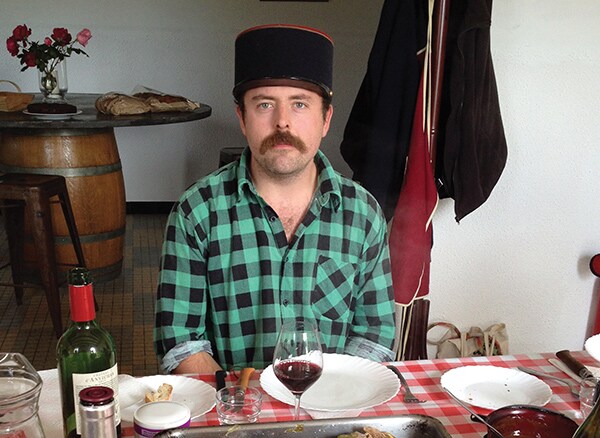
So, as you know, we have Jean-Marc heading up the team, but he’s a busy man, so Vincent Galineau is our Estates Manager and is there full-time. We usually have Clément D’Agostino helping in the cellar, but in mid-February, we packed him off to the Barossa ... his first time in Oz! He was met at the airport by James Luckie – remember Monsieur Luckie? A photo to jog the memory! – and whizzed off to the Barossa to help the team at our sister winery, RedHeads. Three months out there – that should be a real culture shock for our Frenchman.
James Luckie – the most French of all Australians
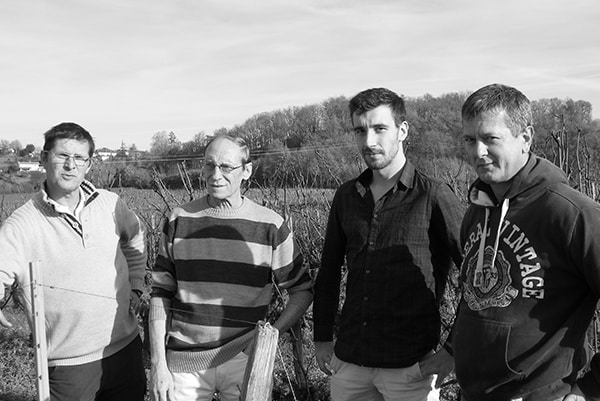
Out in the vineyard on the tractors, we have Frédéric Portaud and, to help him, Jean-Claude Fourcade. Plus, we have a lovely Portuguese couple Vitor and Maria Da Silva Costa. Why so many to oversee the vines? Partly because, as J-M puts it, immature vines are like children – the younger they are, the more attention they need. We’ve also done a fair bit of replanting recently and, as I was explaining earlier, the health of our vineyards is supremely important, possibly above all else.
From left, Vincent, Frédéric, Clément (now moonlighting in Australia) and Olivier – we have three more helping now in the vineyard too. With so many young vines, we need a big team
Vineyard news:
We need that viticultural team for some new projects as well. There’s a lovely block above a little lake on the estate, near to the village church. The land wasn’t right for red grapes, so we’ve drained it, ploughed it, terraced it and in 2019 will plant it with white grape vines. This will shock the neighbours – no one in the appellation grows white varieties. But we want to. Hopefully the quality will be exceptional and we can add the grapes to our Grand Vin Blanc (the 2018 vintage of which has just won a second Gold, to add to the two that the 2017 scored – another cheer!).
Then, we have just bought another 1.74 hectare plot in Sainte-Colombe. When these opportunities arise, you have to jump on them, and fast. We’ve also bought two fields that make up almost a hectare. All our vineyards are extremely close to those of Saint-Émilion, but these new ones are directly next door, touching even.
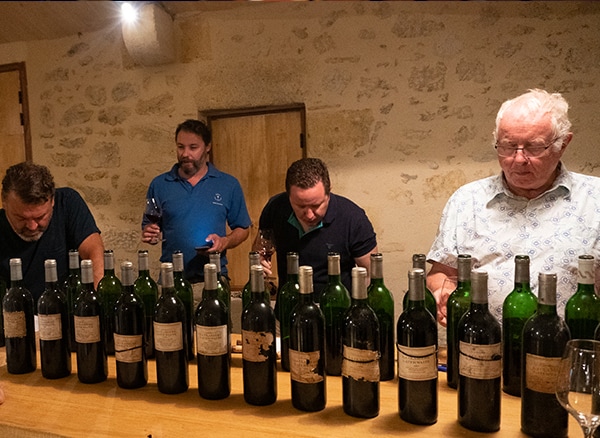
In September 2018, we lined up all 32 vintages of Château La Clarière to do a vertical tasting. It was both heartening that so many were still hugely drinkable – even the difficult vintages – and interesting to see how they’ve developed. A full write up can be found on the Confrère page of our website
Meanwhile there’s much to do with these new areas – they need to be ploughed, planted with those long-rooted radishes to help decompact the soil, analysed ... it’ll all take a while, but we’re planning for the future. We need to take our time.
Castillon – it’s hot property:
As I was saying, these days in Castillon, we have to be super speedy to pick up the best vineyards. Castillon Côtes de Bordeaux is a large appellation, but the number of vines on top of the ridge near Saint-Émilion, the best spots, are small ... and everyone is after them. There’s nothing to sell in Pomerol and Saint-Émilion, or if there is, it’s about £2 million per hectare. Saint-Émilion’s Premier Grand Cru Classé Angélus has invested in our region, building a cellar and buying vineyards – Le Carillon d’Angélus, it’s called. It’s like a cathedral, but with trees and grass on the roof, so very environmental too. That will do nothing except encourage a further rocket of prices in Castillon.
Anyway I’m delighted that, finally, the highfalutin names of Bordeaux have cottoned onto what my great mentor, Monsieur Cassin, taught me 50 years ago – that the wines of Castillon could easily match the quality of the grand ones of its neighbour. We got there first, Confrères, and I’m proud of our achievement, only possible with your support
Your wine, your visit or see you in the UK:
Your Trophy-winning Château La Clarière 2017 (for all Confrères unless you are signed up for the estate white only) will arrive at your door, smartly cased in wood, in June 2019. Look forward to it, make a space in your cellar and, when it arrives, give it a rest. It’ll appreciate being tucked away until Christmas if you can and will keep on developing until about 2030.
Come and try our bottles if you can (saves you opening one!) – at the 40th London Vintage Festival (don’t forget there’s a Confrère lounge), May 10th/11th, at other numerous events all round the country or, best of all, please come and visit us at the château. We’ve been delighted to welcome a good number of you, we’ll have 30 or so on the June trip, but please, sort your holiday plans and include us in your itinerary. Just email us first on:
More tasting events are listed on our website and specific Confrère ones on the Confrère page. It is, after all, our 50th anniversary.
Cheers,
 Tony Laithwaite
Founder Confrère
P.S. The team did a comprehensive tasting of vintages 1984-2016 in September 2018. There’s a write up of each one on the Confrère page and a picture of the line-up above.