Latest News
Latest News
Spring 2017
Hot off the press ...
... there's news of your Château La Clarière 2015 - it's tasting gloriously rich and ripe. No surprise, perhaps, when it's from such an amazing vintage. We were truly delighted with the quality that year ... and, no surprise, so are all the big-name critics.
This time of the year is when we make the finishing touches to the vintage and carefully bottle it, ready to despatch to Confrères. We await, too, with excited expectation, the results from some top wine competitions. Last year, the 2014 proudly took a Double Gold and a Gold; with the superb conditions of the 2015 vintage, we're hoping for even more medals of this hue! This shimmering beauty of a wine is now settled in bottle. Indeed, I've been showing it off around company headquarters. I'm amazed at just how delicious it's already tasting - gorgeous, ripe and delectably fruity ... and at the opposite end of the spectrum to traditional young Bordeaux when forbidding tannins were the main thrust.
Here's my most recent tasting note on our 2015:
A really deep purple crimson hue, with lifted aromas of ripe cassis, dark plum and blueberry woven through with gentle hints of oak spice. It's seductively silky, too, so you hardly notice its firm tannins, which nevertheless will lend it structure to go the distance. It's a luscious mouthful - generous cherry, berry and blackcurrant with a layer of opulent creaminess. And really long. It'll be fascinating to watch it develop over the next 10 to 15 years. But don't hold back, it's delicious now, too.
What the papers say:
No need to believe me or or our enthusiastic head winemaker, Jean-Marc Sauboua, when it comes to the quality of the vintage. Just look at the voluminous praise from critics worldwide. “An excellent vintage ... [that] might pip the quality of 2005 praised Wine Advocate, “a fantastic year ... the wines have a lot of 'wow' factor,” enthused James Suckling; “a joy to taste” said Jancis Robinson MW, “the best vintage since 2010” (Wine Spectator) ... and so the quotes rolled in. After the challenges of the last few years, I, for one, was greatly relieved and positively delighted by the quality of the vintage.
Would it be the rule of five?
There was, of course, lots of talk in the press about 'the rule of five.' Now that's one to drop into conversation with any wine-boffin friends! 1945, '55, '85, '95 and 2005 have all been remarkably good vintages, so the question was, would 2015 prove the rule - that vintages ending in '5' all come out as 5-Star. 2015 seems to say so.
So why and how?
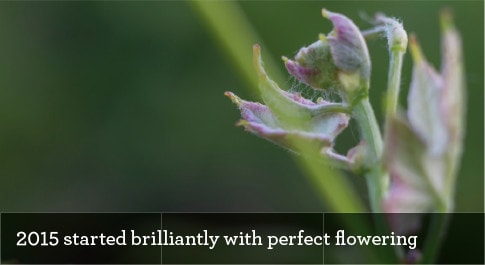
This great year certainly had us guessing all the way through. It began propitiously enough with a lovely warm April, close to a heatwave in early May - in fact, perfect flowering conditions for the first time in four years. A bit of late spring rain followed - nature was really being kind.
I'm not going to regale you with the weather week by week, but will say that May, June and July were the hottest and driest on record and, by the end of July, the region had received 50% less rain than the norm. That's a considerable drop. The young vines felt the stress and, for all vineyards, it pushed back veraison (as the grapes change colour).
Heat and drought usually hit Bordeaux in August, so their appearance in early summer was unusual, as was the plentiful rain through August - topsy-turvy stuff. However, the hot, dry conditions of the preceding months had ensured our treasured berries were small and compact and had amazing thick skins. That was extremely beneficial with the rain that fell in September, even through harvest. Whereas rain at that time can dilute a vintage, or cause problems by splitting the grapes' skins, there was no worry with 2015's crop - all the goodness was safely tucked inside. Cool September nights kept freshness and aroma in the grapes, yet still we waited. And waited, until mid-October, one of the latest harvests to date, to ensure we reached full phenolic ripeness, as we call it in the trade. That means not only ripe fruit but also full ripeness of tannins and other elements that contribute to a wine's colour, aroma and flavour. Very important.
New cellar 'christened' by the 2015:
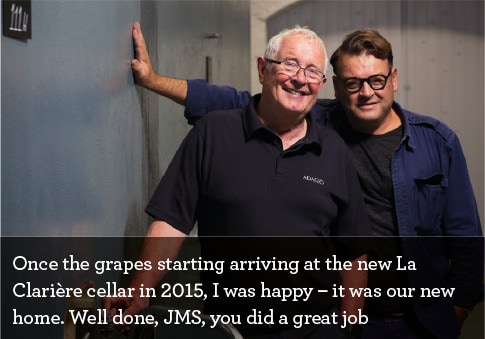
The 2015 vintage was the first in our new Château La Clarière cellar. It was hard for me to let go of the old place just up the hill - the cellar where my winemaking adventure had started back in 1984 - but seeing the first grapes come in and the new winery in action, it felt right, like home again.
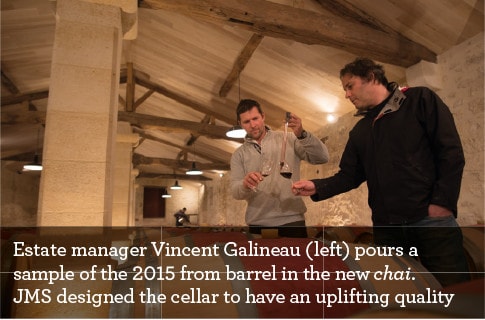
In charge of the project has been our chief winemaker Jean-Marc Sauboua, who had worked unstintingly through the year, along with estate manager Vincent, to have it ready.
We had bought this property in 2011, the cellar something of a Mary Celeste. It's taken us time to work out exactly what we want to do with the buildings; with the vineyards, it was clear.
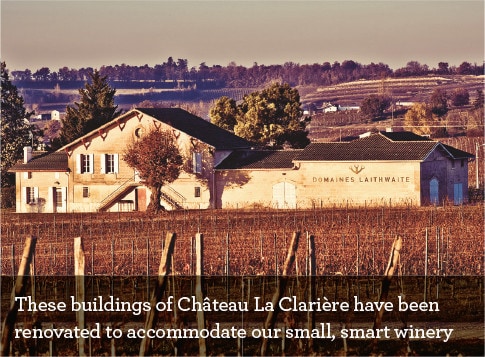
As you'll see if you visit, there is a set of small buildings near the road, within which sat one cellar - the small one. That's the one we've renovated so far ... keeping the old concrete tanks, relining them, adding new taps, new doors, a new cooling system and a good lick of paint. It's looking very smart without being overly ostentatious - a working cellar.
Where's the stainless steel, you ask. Stainless steel is still important, particularly with whites and rosés, but the tide has turned and the benefits of concrete vats are now being recognised. “Old tools with a modern twist,” is how JMS describes them and, if Château Pétrus (among many) uses them, they're good enough for us, too!
Epoxy-lined, these once-spurned-nowfashionable tanks are easy to clean and, with their thick walls, they are excellent at maintaining a cool temperature. We still have little radiator-type things to drop in the vat to warm up the liquid and get the ferment going, but even in the heat of summer, the fermenting juice stays cool. For me, I think the wines from these concrete tanks taste richer and rounder, too.
Above all, we desire finesse:
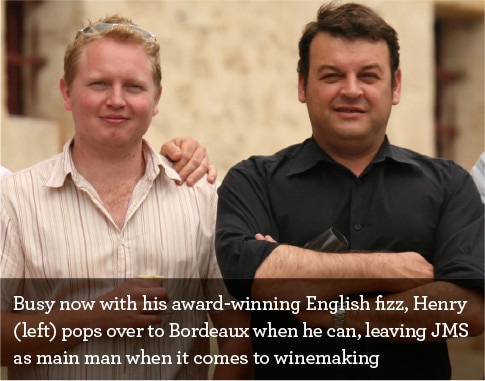
It's not only trends on fermentation tanks that are shifting, we've been fine-tuning our winemaking methods, too. In fact, that's something we've done every vintage since we started back in 1984. You never stop learning in this business. Jean-Marc has been tweaking his methods in the vineyard and in the cellar since 1993, when he first took on winemaking at Château La Clarière. He's been sharing the task with my eldest son, Henry Laithwaite, himself a Parker-rated winemaker. But with Henry's exciting sparkling wine making project in Buckinghamshire, he's had to let JMS take the main strain.
With La Clarière, we've never gone for the bold, heavily extracted type of wine that became the trend with the rise of critic Robert Parker and his notorious Parker points. We do continue to tinker with the style and our use of oak in particular ... all in pursuit of even more finesse. With our new cellar, in 2015, JMS decided plunge down (pushing down the cap of skins that rise to the top of the vat during fermentation) would only happen once a day, not three times, to lend a lighter touch.
Previously, all our Grand Vin has been aged in oak, albeit only a third of it new (the rest one and two years old). For the first time in 2015, only 80% of our wine went into wood, with the same split between new oak and older barrels. It's not a huge difference that would startle our longstanding Confrères, merely a tweaking of the 'recipe', to lend a little extra helping of fruit. And the division between grapes has remained pretty constant - 80% Merlot, 12% Cabernet Franc and 8% Cabernet Sauvignon.
Grapes and vines:
I say the same blend of grapes, but with an extra 25 hectares gradually coming on stream from these new-vineyard acquisitions, the grapes won't necessarily be from exactly the same plots. Whatever, the grapes from these new vineyards can't be included until they've prove themselves first! Only the finest vats - judged purely on taste - are included.
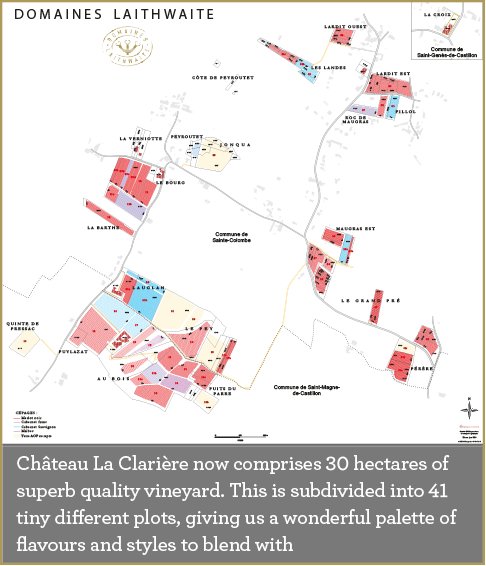
If you look at the detailed map above, you'll see we now have 41 different little plots to work with. That may sound a lot, but they are small patches - fragmented because that's how they come up for grabs ... a few rows here and there. With each vintage, quality will vary a little. It's ideal having this many sites - firstly it gives us a broader palette of flavours and character to blend from. It also spreads risk. Frost, hail and so on tend to hit individual pockets of vineyard, carving a narrow corridor of destruction. Rarely do they strike a whole appellation.
Soil, clones and rootstocks:
With all these vineyards to 'play' with, JMS is really getting into the detail with vines and soils. The old adage is that old-vine grapes always taste better than those from young vines.
However, there's a bit more to it than that, JMS explains ... at length!
He has the assistance of a viticultural consultant, quite a big name in his field, who assists at a number of Grand Cru properties. On a day-today basis, however, viticulteur Vincent Galineau is the main man.
JMS poached Vincent from a very posh Michel Rolland property in Bordeaux's Côtes de Francs. Vincent is Castillon born and bred, very near to our village of Sainte-Colombe in fact, so he has oceans of local knowledge on soils and microclimates. His father was a grower before him and his older brother now runs the old family estate.
So, with all these wonderful new vineyards we've added to La Clarière, just across the road (literally) from a number of Saint-Émilion Grands Crus, JMS and Vincent have been experimenting. Clones, soils, rootstocks, leaf canopies ... it's fascinating stuff, they could write a book on it. With __ hectares in total, they have a lot to experiment with and, with a third of the vineyards, they will start from scratch. This is a major programme of renovation.
Jean-Marc believes that the pointers so far say that a young vineyard, with the perfect rootstock, matched to the right clone with the most suitable soil and with optimum pruning, can produce fruit with the best balance ... and you'll taste that quality in the wine. It's all about detail in the vineyard. Interestingly, Château Pavie in Saint-Émilion uses all young-vine fruit in its Premier Grand Cru. Now, that is a volte face on former thinking.
Imbuing the soil with life:
What hasn't changed is the need for life in the soil. We're still planting a special type of radish between the rows of vines. With its exceedingly long roots, it breaks up the earth, then decomposes to feed nutrients to the soil. We try to be as natural as possible, tread as lightly as we can, so as not to compact the soil, and encourage goody-type insects to ward off the bad ones.
As for grapes being planted ... interestingly, the official Bordeaux body has been handing out incentives for Right Bank properties to plant a little more Cabernet. JMS, however, isn't convinced and, within the replanting programme, he's still favouring Merlot, with an exciting splash of Malbec on the terraces, and he's even contemplating a few, dare I say it, white grapes. This is firmly a red wine region, but JMS is no stickler for tradition and he's excited about the prospect of trialling some Sauvignon Blanc and Sémillon.
We have a soil map to help us. Since we acquired the new vineyards, we've been digging deep holes in every patch, down to about 3 metres, to analyse just what soil we have. Armed with this knowledge we can understand better how the vines will behave and what sort of fruit they will produce. For instance, on the top of the plateau, up above the large stretch of buildings, we have calcaire soils. Grapes from here have impressive structure and complexity that lend themselves to the Grand Vin. Fruit from our sloping vineyards tends to produce wine that's silkier, more approachable and with less tannin - better for early-drinking clarets ... like the supple Château de Colombe.
Buildings:
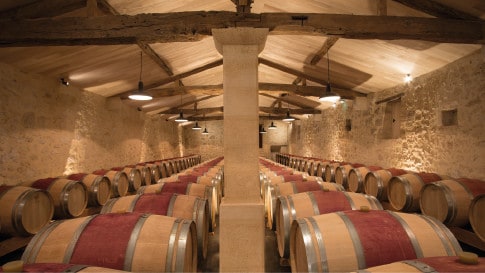
He's a busy man, our JMS. He's not only been deep in thought about what should be going on in the vineyard, he's been working on different building projects, too. Once the new cellar was up and running, the vintage done, JMS started planning the barrel hall. It was finished in October 2016 and holds 100 barrels - that's just one single layer of them, currently full of the 2016 wine. In time, we will probably have to stack them to gain more capacity.
Wine feng shui:
It's a beautiful barrel chai, with a lovely quality of light, and restored using natural materials. Poplar for the new vaulted roof, all insulated using natural hemp. Stone walls and a polished concrete floor (not so natural!). JMS says it's designed to give you a feeling of lightness and well-being - he's very feng shui like that, andthinks it helps the wine develop, too!
Next, a wine library:
Now he has ideas for the building on the opposite side of the entrance arch - to create a wine library. It'll need to be air-conditioned and humidity-controlled, with space for about 100 cases of each vintage going forward, and as many as feasible going back. Confrères will be able to purchase them during their visit.
Beyond that, there is a plan to have a lovely reception room for my Confrères to relax in, sample the wines and so on. We have other ideas as well, but I'll let them firm up a little before we reveal more.
Landscaping for a Laithwaite wedding:
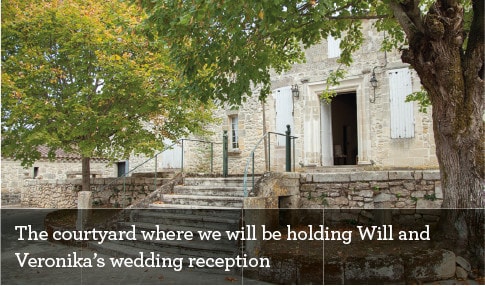
Anyway, JMS says he's far too busy to plan other rooms - he's being a part-time wedding planner. Not for himself, but our middle son, Will, is to be married this summer. Despite being a kingpin in award-winning craft beer, he and his fiancée Veronika have decided to make their wedding truly French. The ceremony will be at Le Mairie in Castillon, followed by a short walk down to Le Chai au Quai for the first party, before the proper sit-down reception and dancing at Château La Clarière. This will really bring the place to life.
It'll be held in the courtyard and JMS is busy with topiarists and gardeners, ordering new shutters for the windows and fancy new guttering, so it looks its best.
Can you guess what wines will be served? Will it be mother Barbara's Gold-medal Wyfold vintage fizz or brother Henry's (also award-winning) sparkler Harrow & Hope? White wines are yet to be decided, but Château La Clarière will certainly be among the line-up.
Further renovations:
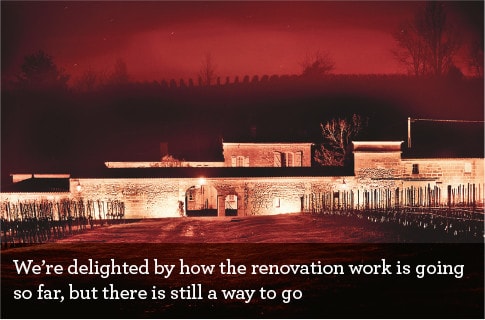
We've already started on the front of the building, stripping down the stone, planting trees, grooming the stones ... and that's not for the wedding. It's so it looks a picture for visits from our Confrères - it's your château. It's not lavish spending - the man in charge of the money wouldn't allow that - just a matter of smartening it up.
The tractor shed will be moving, too, Jean-Marc and Henry have decided. It's currently part of the main château and close to our beautiful barrel hall. It needs to move down to the vinification cellar, to the hard-working part of the property, I'm told, leaving space for, possibly, a small gravity-fed cellar, with wooden fermentation vats perhaps, egg-shaped fermenters and other interesting things to work, in very small quantities, on single-vineyard wines possibly. As I said, early days. I have many ideas, and not all of them will come off.
That's a lot of up-and-coming projects for our small estate. For me it feels as exciting as back in the mid-1980s, when we were first up and running and everything seemed new. I'm really delighted you are sharing this journey with me. I'm certain you'll adore the 2015 vintage of Château La Clarière - so delicious now, yet one that will happily keep for 15 years, too.
Enjoy your wine and I'm hoping very much to see many of you firstly in April at our special Confrère event and also at Château La Clarière itself - the château we share with you.
Yours
 Tony Laithwaite
Founder Confrère